Showing posts with label Melosira. Show all posts

Monday, September 11, 2017

Birding on Lake Champlain


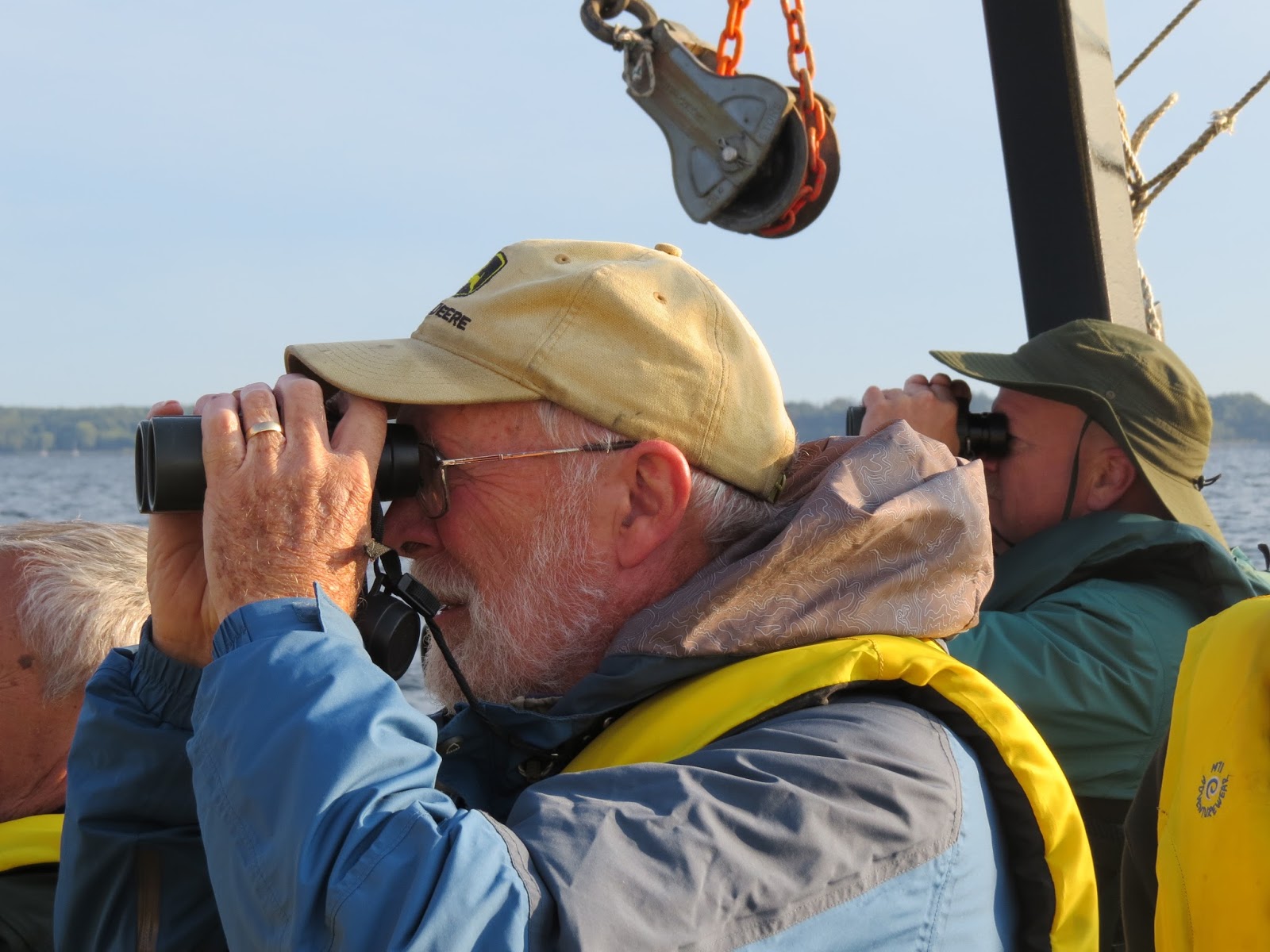
A perfect day for lake birding aboard UVM's research vessel, Melosira! We're in the middle of fall migration, and we're all hoping to see birds that use Lake Champlain as a corridor when they head south for the winter.


Once we got out onto the lake, Allan Strong was in charge of "chumming": tossing small fish in the wake of the boat to attract gulls in the hope that their excited milling around might attract flying fish thieves (aka jaegers).


Jaegers breed on tundra, north of the Arctic Circle. They get a lot of their food by dive-bombing and harassing gulls into dropping freshly-caught fish.


The birders on board were an enthusiastic and jolly bunch so the trip started with laughter and conversation.


Liz

Cat and Clem


Julie

Gail


Don

But there was also a lot of intense scanning - of the water, the sky and the surrounding land.


Liz

Ted


Allan

Michele


Stacy


Ian and Mark


Brenda


Kent


Ali


We saw several species in large numbers: pigeons inside the Burlington breakwater, Double-crested Cormorants, and gulls (Ring-billed, Herring and Great Black-backed). 


photo by Julie Filiberti


photo by Julie Filiberti


Other species appeared one at a time: a Black-crowned Night-Heron, a Great Blue Heron, a Belted Kingfisher, a Common Loon.


Finally - a jaeger!!! 


But which kind? The size suggested Long-tailed, the smallest of the three jaegers - but that's also the species that usually migrates way out to sea and is the least likely to be seen inland. 

Books were consulted. Specific field marks were discussed at length. 


Photos were compared.

Kent and Mick


The conclusion? The bird was definitely a juvenile Long-tailed Jaeger (that hasn't yet grown the characteristic very long middle tail feathers).


photo by Julie Filiberti


photo by Julie Filiberti


Later, we lucked out and saw a second jaeger, this one probably a Pomerine. The identification won't be definite until several photos are studied. 

Boat birding is very different from many other kinds. You can talk and laugh and hoot and cheer, with no fear of scaring away the birds. There are often long periods when absolutely nothing happens - time to enjoy the sun sparkles on the water, the wind in your face, and the friendly chatter all around you - and then there will be a brief explosion of excitement.


Jan, Julie, Roger, Cat


Roger


Maeve

A great postscript to the day, from Liz Lackey: Big thanks to Allan for organizing and orchestrating; to all for helping with the ids; and to Captain Steve for putting the Melosira through her paces without tossing us overboard.

A second PS, added three days after the outing: The mystery bird was identified from photos as a Parasitic Jaeger.

The whole group (minus Captain Steve and crew mate Brad). 


The whole group with Bernie taking the photo and Brad joining us. 


Friday, August 18, 2017

Lake Champlain's Floating Lab - UVM Melosira


Birders spend their time in nature, surrounded by nature. Many of us get interested in dragonflies, or butterflies, or wild flowers. Most become passionate advocates for habitat protection and conservation. Yesterday, we learned about protecting a very special habitat, Lake Champlain.
We went out on the UVM research vessel Melosira 


to learn about biological, chemical and physical measurements made by limnologists (people who study inland waters). 


Maeve tried her hand at steering the boat - while we were still docked!


While Captain Steve motored out into the lake, Kris and Amelia from the Rubenstein Science Lab told the group about the geology and formation of Lake Champlain and its extensive watershed.


The boat stopped and everyone on board used instruments for various measurements. 


The CTD measures conductivity, temperature and depth - and costs $20,000!


Readings from the CTD were fed into a computer program and graphed. The lake temperature was about 72-74 degrees for the first fifty feet down, then precipitously dropped to 42 degrees. 


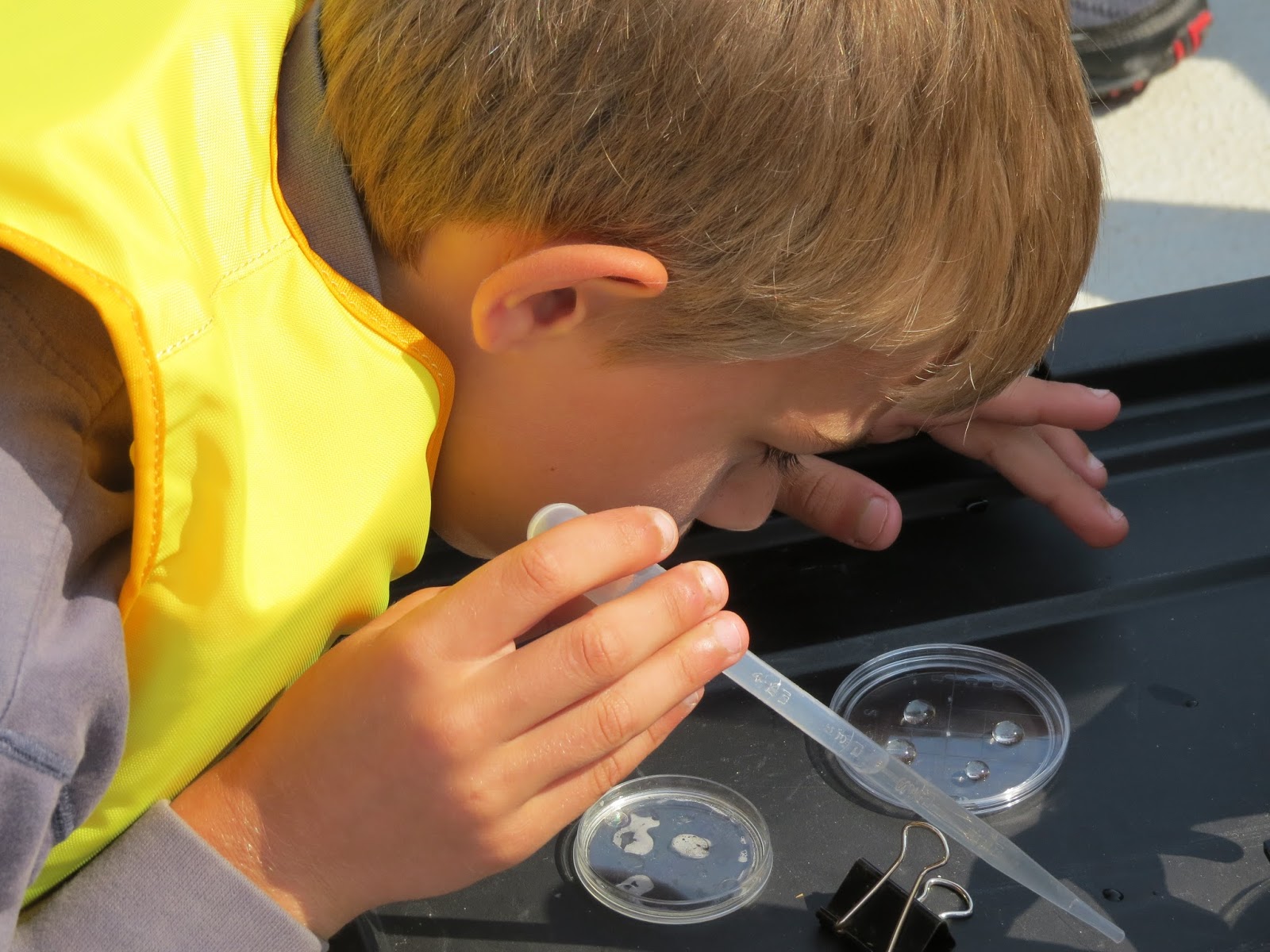
Here's a much less high-tech tool. This little girl was gathering water samples so we could all look at plankton under microscopes.


The cruise was part of the Rubenstein Lab's outreach program, one of three public outings this summer. 
The many children aboard were serious and focused on the scientific tasks.


Even the adults were enthusiastic!


Other public outreach initiatives include classes at ECHO and local schools, providing hands-on learning about the lake to students and their teachers.
Scientists at the Lab also meet with fishermen, officials at marinas and water treatment plants, and people who own lakeshore property to encourage responsible boating and run-off management. One recent success was a change in filters at the Burlington water treatment facility that resulted in an immediate decrease in the quantity of microfibers reaching the lake.


We didn't spend a whole morning without noticing birds! Here's a mallard-domestic duck hybrid seen along the waterfront.


Here's just a little bit of the vast amount of information we learned from Kris, Amelia and Steve on the cruise.


Lake Champlain is the sixth biggest lake in the United States, after the five Great Lakes. 


Vermont's own Great Lake is 120 miles long and 12 miles across at the widest point. The depth reaches 400' deep near the Charlotte-to-Essex ferry route, at the site of an ancient tectonic slip. Most of the lake is much more shallow, and problems with water quality are greater in the shallowest areas such as Missisquoi Bay, Malletts Bay and St. Albans Bay.
Lake Champlain has a much higher ratio of adjacent land to water than the five Great Lakes, so it receives a greater amount of run-off from surrounding mountains, cities, suburbs, forests and farmlands. 
Kris noted that agriculture often gets the blame for lake pollution but in reality, acre for acre, urban areas put more algae-feeding nutrients into the lake than farms. Vermont has much more agricultural land than urban land, though, so the aggregate effect is higher for farmland.


The Lake Champlain Land Trusts web site also offers more information about Lake Champlain.