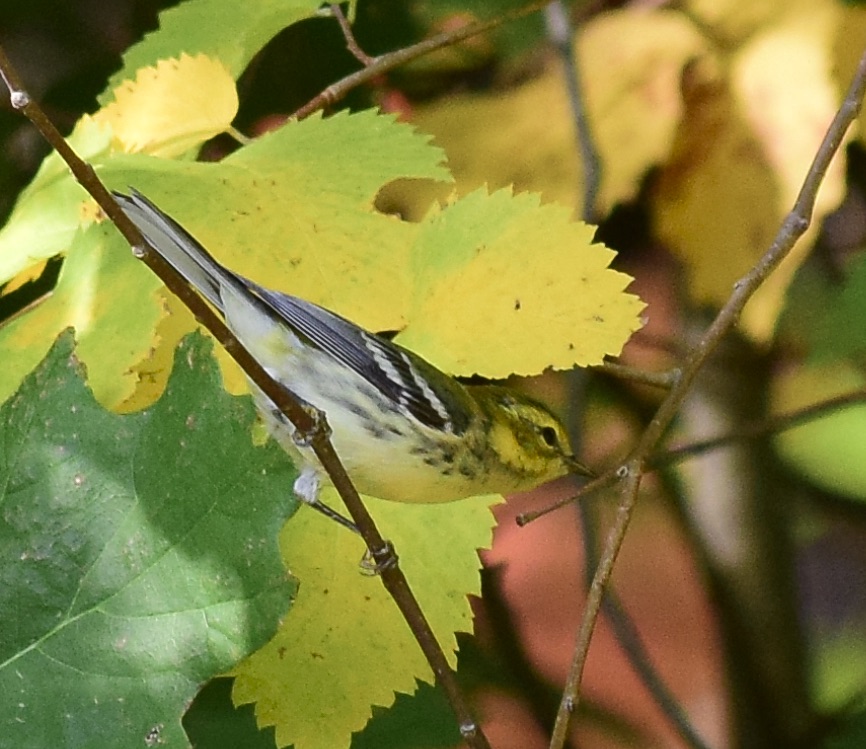
COMING SOON to a backyard near you - Birds, Songbirds, Corvidae, Strigidae (owls), Raptors, and more. Birds of all colors, sizes, silhouettes, and songs.
Slow birding in one's backyard is IN. At least, it has been during Covid times (since March 2020).
Such as it is, we begin our backyard bird journal to share our sightings, our observations, our joy in time spent in our backyard and in our kitchen looking out into our backyard.
August 22
This has been a cuckoo summer! We've heard and seen Yellow-billed Cuckoo(s) several times - and today Bernie spotted an immature Black-billed Cuckoo!
The long-tailed bird was in one of our old apple trees, then a locust tree, then the tall sumac near the house, and finally perched on one of the shepherd's hooks holding hummingbird feeders.

It didn't act like the common descriptions of this species: "elusive", "shy", "lurking". It's an immature bird, probably fledged within the past few weeks, so maybe it hasn't developed a strong fear of humans yet.

June 14
When it rains it pours. In between rain showers, birds came one after the other to our backyard as if they knew the rain was coming. Here is what we observed in the backyard today.
Two male orioles, two catbirds, male grosbeak, song sparrow, three bluejays (one feeding another), mourning dove, chickadee, goldfinch, white-breasted nuthatch, grackle, male and female house finch, red-winged blackbird, down woodpecker, hairy woodpecker, and a hummingbird.
June 13
This morning our resident Baltimore Oriole (every time we see this tropical bird, we get whisked to Arizona again) came to the hanging metal basket where we have a jar lid holding a bit of jelly. Only this morning there was only a scraping of jelly on the lid.
The male deep and brightly orange Oriole seemed a bit nervous, standing on the edge of the basket reaching down for jelly but coming up quickly without any, over and over again. It made a defense or alarm sound like tiny pebbles rattling in a tin can.
Then as if to resolve the situation, the Oriole took the lid cover by the rim in its beak, lifted it, pulled it to the side of the basket at an angle; thus finding it easier to access the jelly without having to bend down so far, and presumably with more comfort and not crouched and leaning over that placed it in more of an exposed position.
And lapping up the jelly resumed.
May 8, 2021
F.O.Y. Baltimore Oriole, and Rose-breasted Grosbeak. Welcome back to our backyard!
May 4, 2021
F.O.Y. Ruby-throated Hummingbird
April 9, 2021
Crows visit the yard fairly often, mostly to check if there's anything new in the compost bins. This morning, we noticed two together in one of the butternut trees. One had a beak-full of thin sticks - and then the second also began breaking off and gathering sticks. A few minutes later, the pair flew off together, carrying the nesting material.
Crows can be seen nesting anytime between late March and early July. Both members of a breeding pair work on nest-building, and they're often joined in their endeavors by some of their young from the previous year.
This kind of help is often seen in avian species that take a few years to mature. Crows don't usually breed until they're two-four years old, so they often hang around their parents and help with their younger siblings. This behavior is in keeping with the general family-loving and sociable nature of crows!
~Maeve
April 8, 2021
My first spring 2021 backyard bird sit. In little less than one hour:
Watched a pair of Hairy woodpeckers copulate. Hope they nest in the yard. We had a pair raise a brood in the yard last year.
Viewed a pair or nuthatches staying tight together. One fed on seed pods on a Locust tree. Twice spotted and heard, a FOY (first of the year) for me, Yellow-bellied Sapsucker. Watched two crows chase a hawk from our neighbors' tree line.
Viewed and listened to (the sound and sun were uplifting) redpolls, grackles, Red-winged Blackbirds, downy, Song Sparrows, and doves. Also viewed robins and juncos.
Watched an as yet unidentified mammal the size of a woodchuck stroll across the border stone wall. Observed spiders, flies, moths, and a very small green insect, ID TBD.
Later in the day, a Fox Sparrow (rust brown almost to orange-brown) visited us. This is the fifth Fox Sparrow sighting in our backyard in six days, and also our first for the year female Red-winged Blackbird. ~Bernie
 |
| Red-winged blackbird |
April 4, 2021
When crows and jays start yelling, go check it out!
Early in the afternoon, Bernie noticed four crows lined up like clothespins along our neighbor's split rail fence. It was an odd sight, but Bernie was intent on building new raised beds for ever-bearing strawberries ... so he went on his way.
An hour later, there was a tremendous ruckus across the street. Three or four crows were whirling, diving, yelling, filling the yard with movement and sound.
And then Maeve saw a much larger shape, first in the middle of the crow whirlwind and then escaping to a nearby tree. The crows followed, circling in front of the bigger bird, diving at it in short attacks, backing off to mount another attack.
The big bird was a raven, and it was holding something small and bloody between its talons. Apparently unconcerned by the still complaining crows, the raven pulled apart and ate the small creature.
Later, we wondered if the crows and raven alike had been attracted by some roadkill, if the fence-sitting crows had been taking turns eating until the larger relative swooped in.
Ravens are wonderful birds: smart, playful, devoted to family, and creative. Here's a photo from a New Mexico birding expedition.

There are so many things going on around us, other creatures living other lives. Our own lives are greatly enriched whenever we notice them! ~Maeve
March 26, 2021
For the second day in a row, a Fox Sparrow has delighted us with its visit.


These large chestnut and gray sparrows nest in central to northern Canada, most of Alaska, and down the spine of the Rocky Mountains. They spend our winters in parts of the southern half of the U.S. and along the coast of California. ~Maeve
We see White-breasted Nuthatches all the time in our yard, but their diminutive cousins are rare visitors.
Red-breasted Nuthatch
March 25, 2021
Oh come all ye faithful, join in adoration, spring is here; let the buds burst open, the insects awaken, bluebirds rejoice in song, but stay resolute ye spring-spirited folk, for beware the March folly that often dumps cold white blankets over the parade.
Be resolute, resilient, sustain this early joy, for she will soon be well entrenched less a brief repose or two. ~Bernie
March 24, 2021 Our first backyard Journal entry.
We thought the single redpoll at the feeders this morning was a sign the others (we have been viewing upwards of 40 to 100 at a time) had decided it was time to fly home to northern Canada.
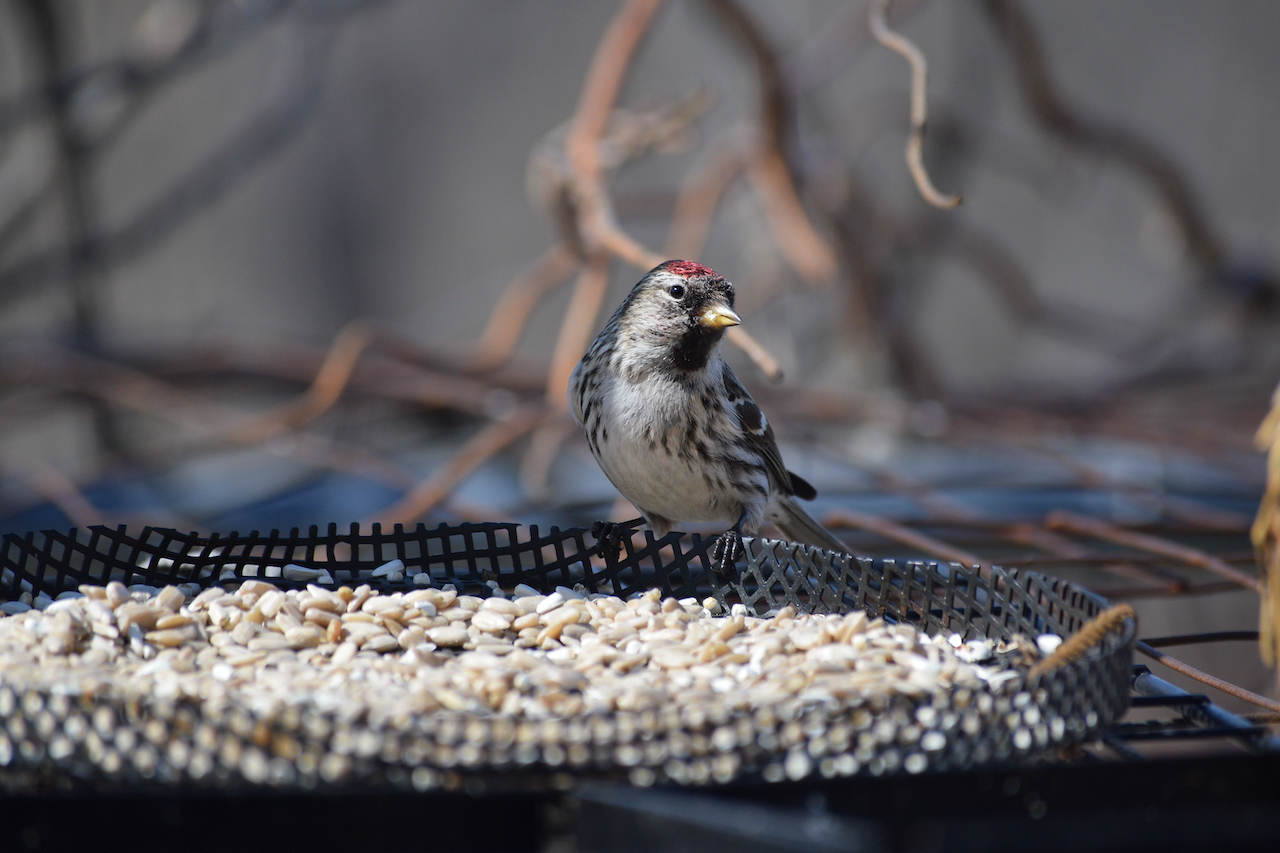 However, this afternoon, very soon after adding more shelled sunflower seed to the tray feeders, around 40 redpolls fell out of the oak tree and crowed the tray feeders, and littered the ground.
Then to add frosting to our cake, two, instead of the much-appreciated single visitor we have been viewing over the last few weeks, two red-breasted nuthatches dropped in for a peanut. (We set out unsalted peanuts as well as the sunflower seed.)


Bernie & Maeve