Showing posts with label fall migration. Show all posts

Sunday, October 11, 2020

PANDEMIC BIRDING CONTINUES TO DELIGHT!

It's still going on!!!!


Starting in early spring, we began sharing some of the birds we were seeing right here in our own backyard - and our thoughts about nature's healing powers at such an anxious and frightening time in the world and in our own nation's history. We called our first posts Birding at Six Feet, and many other birders contributed poems, musings and photos about their at-home birding adventures. We even saw a rarity: a hybrid between a Dark-eyed Junco and a White-throated Sparrow!


And then the orioles arrived! When these brilliantly-colored beauties finish their long flights from Florida or Central America or even farther south,  they need insects and juicy sugar-filled fruits to replenish their reserves of strength - but we had a late, cold spring here in Vermont. Flowers weren't blooming and the usual big hatches of flying bugs just weren't around. All over the state, people reported usually-shy orioles coming to eat suet at backyard feeding stations, or hanging onto the perches on hummingbird feeders to sip some nectar. 

We put out nectar, suet, chopped up fruits, and lots and lots of jelly. And we had Baltimore Orioles in the backyard, a few feet from the kitchen window, every day for a month!

We wondered if birding at home would continue to be wonderful, or whether we'd begin to feel increasingly "antsy" and want to venture farther afield. 

But our one-acre lot has continued to attract birds that, in turn, attracted our eye and our attention. Here are some of the birds we've seen over the last two weeks.


A big surprise and a first ever for this yard: At least three Scarlet Tanagers, an adult male all splotchy from molting, an adult female and a first-year male. Here are other views of the molting male, the female and the young male:


A pair of Gray Catbirds nested in the swampy part of our yard, fledging at least two youngsters. The family stuck around until 10/7, chowing down on wild grapes.


One of the catbirds spent many minutes apparently playing with a stick, like a drum major twirling a baton!


"Our" Common Yellowthroats were constant companions, searching for insects among the cattails, the fruiting trees and shrubs, and the vegetable garden.


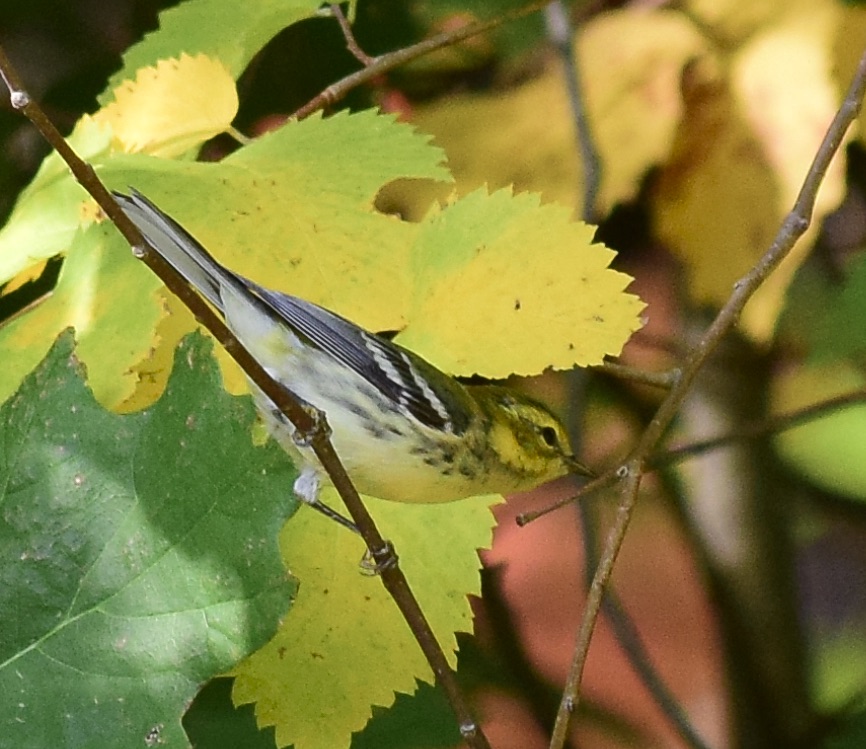
Other warblers that have visited include Black-throated Green, Tennessees and Cape Mays. (We also saw many Yellow-rumped Warblers.)


A recent surprise - and another first for the yard - was a Golden-crowned Kinglet!

.


Winter sparrows are starting to show up. They'll be around until spring, cleaning up dropped seed under the bird feeders (once it's safe to put the feeders up).

White-throated Sparrow


And we've been delighted to again host a lovely little Carolina Wren, a species that's been expanding its range northward.


Birding mostly in our backyard and on dirt roads in Jericho has turned out to be a real treat! Check out Bernie's blog posts about these walks by clicking this link and then exploring all the other parts of this series.

A friend asked, "How do you two keep such a big garden and still have time to take all those photos and see all those birds?" Here's what a birding gardener looks like!

photos by Bernie, words by Maeve


Sunday, September 6, 2020

FALL MIGRATION - FIRST STOP, JERICHO!!


Every birder we know remembers his or her first experience with the scope and sheer size of migration. We can read that between three and four billion birds fly over the U.S. every spring and summer, but it takes a particular incident to bring that statistic to life. For many, it’s the huge flocks of Snow Geese in Addison VT. For others, it’s hawk watches on Mt. Philo or Putney Mountain or – even more amazing – someplace like Veracruz where tens of thousands of raptors pass overhead in just a few days. And for others, it’s a “fallout”, when hungry and exhausted birds hit a wall of wind or a storm and tumble out of the skies en masse, landing on ship railings, lawns, trees, houses and cars.

This fall, our own backyard has given us a hint of migration wonders. On August 31, we strolled outdoors for our morning “hello” to the gardens, and we immediately realized that this was no ordinary day. There was bird noise everywhere! 

We ran inside to get binoculars and a camera, and we spent the next two hours so excited that we didn’t even complain too much about the dreaded “warbler neck” from staring up into the trees. 

The most exciting – and initially baffling – bird was a male Scarlet Tanager, the first we’ve ever seen in our yard. 

He appeared to be molting and was a colorful mishmash of red, black, yellow and orange instead of a tanager's usual rich red body and jet black sides. 

(Except for the photos of this bird, all the others in this post were taken earlier. We were too stunned to get a lot of photos!) 

There were nine species of warblers, including the Common Yellowthroats that nested and fledged young in the wet part of the yard. 

These little cuties have visited us every morning since early May. They often hang out around the vegetable garden, apparently finding bugs.


We also had Chestnut-sided Warblers nest either on our property or right next door, and one or two showed up in the August 31 excitement.


One lone Black-and-white Warbler imitated a nuthatch as it looked for insects on tree trunks.
(photo by Tyler Pockett)


A small flock of Yellow-rumped Warblers gleaned in the old plum trees. (photo by Sheri Larsen)


The golden heads of Black-throated Green Warblers glowed as they hunted for bugs.

The name "Black-throated Green" really doesn't do justice to these handsome birds!


                             photo by Jane Ogilvie


A Tennessee Warbler was an unexpected thrill! 

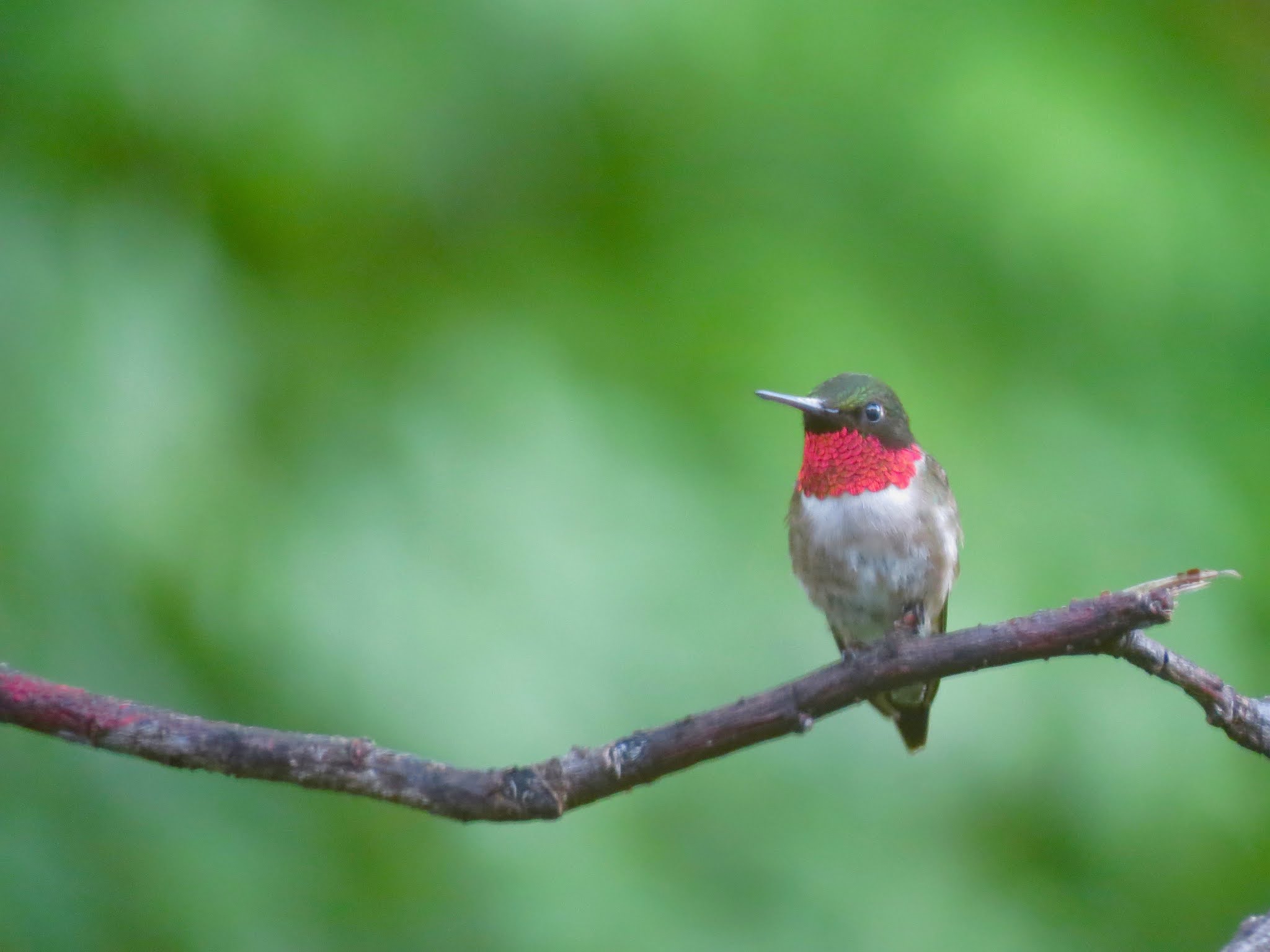
Ruby-throated Hummingbirds whizzed from one patch of jewelweed to another. (This was the last day we saw the male. He must have departed for Central America the very next morning.)


That morning, we identified twenty-seven species of birds. Some (like Mourning Doves, Downy and Hairy Woodpeckers, chickadees and titmice) were year-round residents. Most, though, were southward-bound migrants. 

Migratory birds need a lot of food! Many birds that nested and raised young here in Vermont spend our winters in South or Central America. Some fly out over the ocean, nonstop, for an entire day or more. They spend weeks fattening up before starting out on their journeys, and they love both sugary fruits and protein-rich caterpillars.

The birds in our yard were active in two tall wild cherry trees, two old apple trees (apple trees are great for yummy caterpillars) and plum trees, and a big oak. (One oak can support over 300 species of caterpillars!)


Another migratory rush came through the yard on September 3, when we watched at least three Rose-breasted Grosbeaks chowing down on bugs and the few remaining nanny berries. Catbirds feasted on wild grapes, the Common Yellowthroat patrolled the veggie garden, and "our" Eastern Phoebe perched on dead branches and darted out into the yard after flying insects.


Back in the spring, we wrote about having to stay at home for birding because of the pandemic. We have found unexpected joy in backyard birding!


Enjoy fall migrating birds as well as our year-round resident birds! 
photos by Bernie, words by Maeve 


Tuesday, October 2, 2018

Monhegan Island for Fall Migration!

Monhegan Island is off the southern coast of Maine, about 10 miles out into the Atlantic. It's only a mile and a half long and a half mile wide but it's a very big place for bird-watchers, especially during fall migration. 


Nashville Warbler

Red-breasted Nuthatch


Yellow-rumped Warbler

White-throated Sparrow


Warblers, thrushes, vireos, sparrows, nuthatches, orioles, wrens and other songbirds refuel before heading out over open ocean, relying on the island's abundant berries, grapes, apples and flowers (including over 400 kinds of wildflowers!) and on all the yummy bugs attracted to the plants. 


Hawks and falcons rely on the influx of smaller birds for their own refueling! In four days, Maeve saw Sharp-shinned and Cooper's Hawks, Northern Harriers, Peregrine Falcons and Merlins. 

Migrating flickers and resident crows and ravens add to the constantly changing bird-scape. 


Seventy percent of the island is a nature preserve 
protected by a trust. 


Close to the harbor is a lovely little village with winding, curving, up-and-down dirt roads that are used more for walking than for the island's few motorized vehicles.


the Monhegan School


Small vegetable gardens are tucked in all over the village. A local group runs a farm stand and makes cider from the island's many apple trees.


Birds (and birders) don't always choose locations for their intrinsically scenic beauty. The grapes growing on this fence are bird magnets, so this was a reliable spot for seeing Baltimore Orioles, Gray Catbirds, Northern Cardinals, and Black-throated Blue Warblers. 


Monhegan Island is steeped in history. 
Native Americans fished the waters as many as 5000 years ago. Basque and Portuguese fishermen visited before 1600. Samuel de Champlain explored the area in 1604 and Captain John Smith ten years later. Visitors can learn about the island at the Monhegan Historical and Cultural Museum. 

Across the harbor is Manana Island, usually described as "unpopulated" although one man lived there for many years and now another person has sheep, goats and chickens there. There's an abandoned Coast Guard outpost on the other side of the small island.


Fire is a real danger on the island, especially during an unusually dry year like this one.  There are fewer than 75 year-round residents, making for a very small fire department. 


In the event of fire, any nearby person grabs hoses from plastic boxes scattered all over the island, to help the firemen.

A bit of the underground water pipe is visible to the right of the yellow stick.


Many people come to Monhegan for the walking and hiking trails. There's a perimeter trail along some of the highest cliffs in Maine as well as several cross-island trails through thick woods.


Along with birds, Monarch Butterflies use Monhegan as a stop-over on their annual migrations.


There are three main industries on Monhegan: tourism, art, and lobstering.  

It's odd to walk along a lovely forest path, see a patch of bright color ahead, and find out that it's a pile of lobster buoys!


Most of the hundreds of lobster traps on the island seem ready to be used at any moment - but a few piles have obviously been in one place for a long time, long enough so that plants grow six or eight feet tall right through the pots!


Fishing is such an integral part of the island that fishing net is used to deliver firewood!


Monhegan has been an artists' colony since the mid-nineteenth century. There are many studios, art shows, and sculptures.


Even the weather vanes are pieces of art!


Everywhere, all around, at the end of every trail, on every horizon, is the Atlantic: the sound of crashing waves, the smell of salt air, the strong winds and fog, and the staggeringly beautiful ocean vistas.  


This is the fabled rock-bound coast of Maine, where cliffs and tumbled rocks are sandwiched between the waves and the forests of spruce and pine.


These are dangerous waters, with a long history of ship wrecks. 


Visitors are warned not to swim in the cold waters off Monhegan (except from one small beach). 


Lots of ocean means lots of birds: Northern Gannets, Common Eider, Herring Gulls, Great Black-backed Gulls, Double-crested Cormorants, and diminutive Black Guillemots. Bald Eagles can also be seen on the ferry ride from Port Clyde to Monhegan.

Common Eider


Notice all the guano on this island full of cormorants and gulls!

distant Black Guillemot

Monhegan is worth a visit any time, for its beauty, its history, its culture, and the hardy perseverance of its fewer than a hundred full-time residents. Many dwellings don't have electricity or have power for only part of the day. Many buildings, including the two large inns, don't have heat upstairs. Food that isn't raised on the island has to come in by boat, along with the mail. But the local people continue to celebrate life with art, poetry and music!

Here are some more photos:


PS - I have to add one astonishing adventure: I was sitting on a dirt road near where someone often spills bird seed, where I'd seen several different sparrows the day before. I chose a shaded spot by an old apple tree, thinking that perhaps the shade would help keep birds from noticing me. Sparrows came, and jays and Mourning Doves, and even a rat. Suddenly, I heard small noises from right next to me. I turned my head cautiously - and I was just over a yard away from a magnificent male Cape May Warbler, intently eating either the fallen rotting apples or the little bugs on the apples. The warbler seemed completely oblivious to me. Soon it was joined by a second Cape May, this one a female. Then by three or four other warblers - and then I was joined by three or four other birders. Two got great photos of the Cape Mays, I think. I had been too awed by the birds' closeness, and too afraid that a lot of movement might frighten them away, that I never even got out my camera. This was the closest I've ever been to these beautiful birds, and probably the only time I'll ever see them on the ground!

In all, I got good, long and repeated looks at thirteen species of warblers, even with incredible wind one day and rain for parts of two other days. 

I treated myself and stayed at the Island Inn: great room and truly excellent food! - Maeve