Saturday, June 18, 2022

More Spring Beauties (Birds, Plants and Critters)


Tree Swallow

We promised ourselves that we would make the most of spring migration this year! We were eager  to see returning Tree Swallows back from the warm winter retreats in the Yucatan or on some Caribbean island ... and the first long-distance shorebirds flying in from Brazil or Chile.

Least Sandpiper - the smallest sandpiper in the world


We were delighted to see new life, like this Canada Goose family along the South Hero Marsh Trail (aka Roy Marsh Trail). 


We walked our own yard almost daily.

Scarlet Tanager in our yard!

As far as we know, tanagers aren't nesting nearby - but the following are nesting right here on the property: American Redstarts, Common Yellowthroats, Gray Catbirds, Northern Cardinals, Eastern Phoebes, American Robins, Chestnut-sided Warblers, Black-capped Chickadees and Tufted Titmice. Flickers, Blue Jays and Ruby-throated Hummingbirds apparently are also nesting very near to us.

American Redstart


Chestnut-sided Warbler


Common Yellowthroat

Cedar Waxwings descended on our yard in groups of ten to twenty. Somehow they always know exactly when our honey berries are ripe.


Everywhere we went, there was spring!

Song Sparrow nest among the seedlings at a local nursery!

We visited Chickering Bog (which we've wanted to see for ages). Showy lady slippers were in bloom, along with carnivorous pitcher plants just waiting for unwary insects.


Pitcher Plants (carnivorous)

We hiked at Colchester Pond - always a delight - and stayed overnight at a wonderful airbnb in Addison County so we could bird many local hotspots for two whole days. 


our last stop, on the way home


Wood Ducks


We led an OLLI-UVM bird walk in Shelburne, our first in-person guided walk since this endless pandemic began. 


This Field Sparrow along the Ti-Haul Trail was one of many birds we've seen carrying nesting material or carrying food to their young.


We also spent three days birding, walking and hiking in the Champlain Islands.
 

our favorite of all the places we walked!

At Pelot's, we were spellbound by a  drama over our heads. A loudly calling Cooper's Hawk chased a Turkey Vulture round and round - and then an Eastern Kingbird appeared, chasing the hawk! (We were, and still are, puzzled about why the hawk felt that it needed to chase away a Turkey Vulture, a bird that isn't a nest predator and very rarely takes live prey. Maybe parent birds are just hard-wired to chase anything that looks like a potential threat.)


Cooper's Hawk chasing Turkey Vulture


Other sightings: 


Anchor Stink Bug

pollinator with LOTS of pollen!


and, last but definitely not least, a Long-tailed Weasel in the yard!


photos by Bernie, text by Maeve


Wednesday, May 11, 2022

Have You Ever Seen a Foybird??

They're here!!!!

Common Yellowthroat - male


Spring Migration is in full swing.

A few weeks ago, we posted about the start of this amazing time of year: the welcomed arrival of the first male Red-winged Blackbirds, Killdeer calling from fields, American Woodcocks doing their evening courtship dances. Flooded farm fields full of dabbling ducks. Turkey Vultures soaring on stiff wings, searching the landscape for tasty carrion. Tiny Ruby-crowned Kinglets, never still, always active, singing the loud sweet songs heard only in early spring. 

The first insect eaters arrived right on schedule: Eastern Phoebes checking out last year's nesting locations on porches and under barns, and Tree Swallows claiming bluebird boxes for their own.

Great Blue Herons and American Bitterns returned to Vermont's swamps and wetlands. Osprey set up housekeeping.

And now it's May - and new birds are arriving every single day. 

Birders talk about FOY birds, for First of the Year. And we have seen a lot of FOY birds in the last few weeks.


Yellow-rumped Warbler - female

May is warbler month. A few of these usually small, usually colorful, and usually active birds arrived in April, after astonishingly long flights from the Caribbean or South America - but the main push is happening right now. 

In the last few days, we have enjoyed Pine Warblers, Yellow-rumped Warblers, Common Yellowthroats, Yellow Warblers, Black-throated Blue and Black-throated Green Warblers, an American Redstart, and one large and impressive Palm Warbler. Take a look at a few of these beauties!

Black-throated Green Warbler - photo by Jane Ogilvie

American Redstart


Palm Warbler


Yellow Warbler


Common Yellowthroat - female

We've also seen two members of the warbler family that don't sport the dazzling colors of many of their relatives. Ovenbirds have colors that blend well with the forest floor where they make  their little "pizza oven" nests. And Northern Waterthrushes really do look like thrushes; they're a lot bigger than most warblers and are dressed in streaky browns, tans and grays. 

Northern Waterthrush - immature (photo from last year)

Many other species have also returned to Vermont. Gray Catbirds are singing, copying, "meow-ing", squeaking and whistling from thickets and brushy areas all over the state. For several years now, we've had a pair nest in a part of our yard that has fairly dense foliage - and a few days ago, we saw one bird checking out the area.

one of our Gray Catbirds


The early-arriving Tree Swallows are now sharing the skies and the bugs with other species of swallows.

Barn Swallow

We haven't seen this species yet this year, but Great Egrets are being seen all over the state. This is a bird you can't overlook!


Great Egret


May brings lots of other wildlife, too. Moths and butterflies are beginning to be seen. Bumblebees are busy all over the yard, along with several other kinds of bees. 

Mourning Cloak Butterfly

And garter snakes are basking in patches of sunlight, warming up after their long winter sleep.


This is an amazing and heartening time of the year, giving us all intense pleasure, beauty and hope. We urge everyone to get outside and enjoy it!

[text by Maeve, photos by Bernie unless otherwise credited]


Saturday, April 16, 2022

SPRING MIGRATION!!

Right now, it's "snraining" outside, pouring down a cold mix of snow and rain. The skies are leaden. The day is dreary. 

BUT our all-winter flock of goldfinches is still around, dotting the lawn with a dozen shades of yellow and ochre. 

American Goldfinch


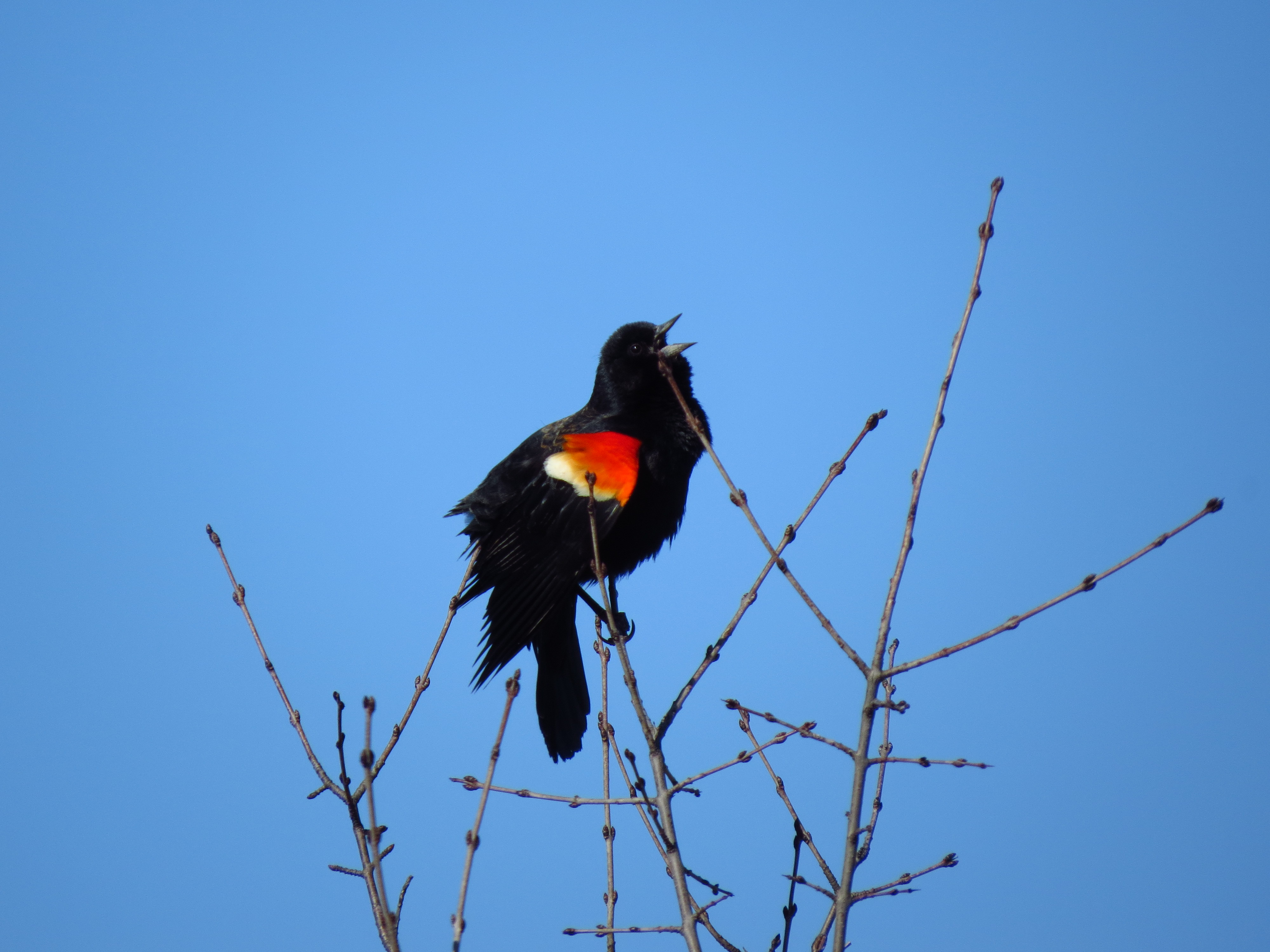
Red-winged Blackbirds are singing, and we are well into spring migration - the most exciting time of the year! 

As soon as they arrive, the males start scouting out good breeding territories. They'll choose their favorites and then they will begin to announce, loudly and repeatedly, that they're ready and able to defend the area and that they're ready and able to find a mate and start the all-important business of reproducing. 


Females will be here in the next few weeks, and they will carefully check out each offered territory, looking for nesting places, nesting materials, good cover from predators, and the absence of obvious dangers such as wandering cats or dogs.

MARCH

Spring migration starts in early March (or even late February!) and will continue though May. Male Red-winged Blackbirds were the vanguard, followed soon by Common Grackles and then Brown-headed Cowbirds. 

We humans often notice those three species because they come to backyard feeders. Other birds, which don't visit feeders, have already returned also, including three diverse members of the huge shorebird family.

Killdeer are blanketing the state's fields, golf courses, and even flat gravel roofs.   

This Killdeer laid her eggs on a little scrape in the midst of hard pointed rocks!

American Woodcock males have begun gathering on "leks" (special areas cleared for male courtship displays). 

Wilson's Snipes are skulking around on the edges of swamps. Soon the males will be doing their courtship flights over swampy areas, making a somewhat eerie noise with their feathers that's known as "winnowing".


Some much bigger birds also return to Vermont in March. Turkey Vultures are often the first, soaring without flapping on wings held in a slight V - true wind masters!

They are soon joined by a few Black Vultures, birds that apparently rely on their cousins' better sense of smell to locate carrion.


Osprey are already atop most of the man-made nesting platforms in our part of the state. 


Double-crested Cormorants can be seen flying a foot or so above the water or drying their wings on buoys or logs.

Great Blue Herons are busy rebuilding their messy stick nests for another year. 

APRIL

More herons arrive in the north country in April.


American Bitterns have been seen in one of their favorite places: the marshes at the south end of Shelburne Pond.

A Black-crowned Night Heron has returned to the Stephen Young Marsh at Missisquoi National Wildlife Refuge.


Green Herons and Great Egrets are on their way and should arrive within the next two weeks or so.

Tree Swallows are swooping over swamps, ponds and fields in many locations. They're usually the earliest swallows to arrive back in Vermont.

Ruby-crowned Kinglets are suddenly everywhere, filling woods with complicated exuberant songs that seem much too loud for such tiny creatures.

photo by Peter Swaine


Eastern Phoebes have begun checking out the places where they nested last year: atop porch lights, under barns, on old Christmas wreathes.

Bald Eagles - year-round residents in Vermont - are nesting already.


Eastern Meadowlarks are back - few and far between, with drastically reduced numbers as is the case with grassland birds all over the world. Yesterday (4/15) they were seen and heard in several locations including Lagoon Road in Hinesburg and along Hawkins Road in Ferrisburgh.

Migratory dabbling ducks - Gadwalls, Blue-winged Teal, Northern Pintails - are in flooded fields everywhere, chowing down on vegetation and invertebrates. 

In a few weeks, we'll continue this post with all the excitement that happens in May - when there's a new species just about every day. Vireos return, and wrens. And  the bright colored birds Orioles! Warblers! Indigo Buntings!

by Maeve - with lots of photos by Bernie, a few by Maeve, and one by a friend and fellow birder


Thursday, February 10, 2022

My Lifelist Focaccia!

I stood atop a ten-foot bank, looking down at the clear still water of - I think - Waterbury Reservoir. The sky was gray and a slight breeze made me glad I was wearing my old fleece jacket.

Waterbury Reservoir

The two people with me weren't birders. They were staring out into the middle of the reservoir, talking about boats and fish.

Bored, I turned away from them - and my eye was caught by what looked like a Northern Flicker. 

Northern Flicker - not what I was seeing!

Sort of. The bird, which was standing on a little rock surrounded by water, had the same size, the same shape. It had the same strong, slightly curved bill. It had the same spotted chest and belly. It even had a mustache. But that mustache, like all its other colors, was muted, even muddy. Its back was more gray than brown, and the back of its neck was a dark dried-blood purple instead of the proper Valentine's Day red.

I moved two steps to my right, along the edge of the bank. The bird must have noticed my approach, because it abruptly threw itself off its perch - and dove right into the water. I watched it swim, expertly, quickly, a foot or two under the water, heading for a little inlet. 

I turned to my companions, but they had wandered away.

"That is NOT a flicker!" I said to myself, aloud. "Flickers do not swim!"

I got out my ever-present birding notebook and started taking notes. Location, time, size and shape and general color of bird. Behavior.

Ah, yes. That's where it got interesting! Behavior! 

The bird neared a large rock and swam to the water's surface. Once there, it balanced on the water with one foot, reaching its other foot up - and then reversing, standing on the other foot, reaching with the other. 

"Bird apparently knows how to climb stairs," I wrote.

After a few seconds of finding no stairs, the flicker-that-wasn't-a-flicker threw itself out of the water and onto the large rock, where it walked to the center and started preening.

"Bird walks, not hops," I scrawled.

At that moment, I sensed someone behind me. I turned and was pleased to see a birder I knew.

"Take a look at the bird on that rock over there!" 

"It's all wet," he observed.

"Yes! It was just swimming. Underwater. Just like a dipper."

"Not possible," he opined. "There are no dippers in the east. And anyway dippers don't look like that."

"I know. I've seen dippers."

a Dipper I've seen

"But this bird, that looks like a dull-colored flicker, just dove under the water and swam fast and efficiently for several yards."

"Hmmm," he ruminated. "Peculiar. We might have ourselves a rarity."

I dug out my tattered Sibley and he got out his iPhone. 

"You check Sibley for rarities," he instructed. "I'll try Whatbird.com."

Several minutes passed. The bird preened and air-dried. The two of us studied, hunted, researched.

"Nothing even remotely similar."

"Well," he said, "I may have something. How's this?"

And he held his phone out to me.

And there was the bird! Our bird! It was exactly what we were both looking at through our binoculars. And it was far, far, far away from home! That flicker-like, dipper-like bird was nonmigratory, a diving bird that frequented deep still lakes in the wilds of Outer Mongolia.  

"What's it called?" I whispered, hushed now that I understood the enormity of the sighting. 

"Mongolian Focaccia," he whispered back.

"Hmmmm," I mused. "That name sounds familiar."


And then I woke up, grinning.


(Here's some real  focaccia - not good underwater, and not from Outer Mongolia.)


Some e-mailed comments:
That was laugh out loud funny—thank you!  - VT
That was such a great story. Thanks for sharing it in detail!  - PA
That is extremely funny!  Thank you! - VT
Loved it - and laughed!! - OH